Affichage des articles dont le libellé est Amazon. Afficher tous les articles

mercredi 23 avril 2014

Amazon’s Magic Wand and the Unrelenting Race to Make Shopping More Convenient

In the last two months, Amazon has spotlighted two new products that allow shoppers to add items to their shopping list without ever typing anything into a search bar. This isn’t a coincidence.
The most recent one is Amazon Dash — a thin, wand-like device, revealed on Friday, that includes both a microphone and a barcode scanner. Speak into it or scan a box of cereal or pack of toilet paper to automatically add that product to your AmazonFresh shopping list. For now, it is available only on a trial basis to Amazon customers in San Francisco and Los Angeles who pay for Amazon’s new Prime Fresh membership, which includes grocery delivery.
Before Dash, Amazon announced in February that it was adding a technology called Flow to its main shopping app on mobile phones. A user taps on the Flow feature in the app, points the phone at a product in their home — say, a book or a bottle of shampoo — and Flow is supposed to quickly display the product page on the phone’s screen.
Both Dash and Flow seem a bit gimmicky now. And I have no idea whether either will ever move past that stage and toward mass adoption. But they are both signs that Amazon is seriously thinking about how to remove as much friction as possible for people who are looking to buy a specific item from Amazon, but are on the move and not sitting behind a desk staring at a computer screen.
In an interview earlier this week, Paul Cousineau, Amazon’s director of mobile shopping, said that his division spends a lot of time thinking about how to make it easier for shoppers using touchscreen devices to quickly find the products on Amazon they want to buy.
“If you never had to type again on a phone that would be great,” he said. “We want you to go from ‘I want that’ to ‘I bought that’ in 30 seconds or 10 seconds … a very short period of time.”
And the hope is that Flow will eventually lead Amazon to that future. “I’d like to see this be our primary search model,” he said of the Flow technology.
As for the Amazon Dash device, it’s a different approach to the same company goal of giving its shoppers the quickest path to load a bunch of goods into their shopping cart wherever they might be. Is it that hard to look in your cabinet at the brand of pasta you are running low on, and then search for it on Amazon at the laptop on your kitchen table? No, not even close. But, thanks in large part to Amazon, we are living in a time where speed and convenience in shopping often seem to trump all, for better or worse. And Amazon is placing a small bet that using the Dash device will be quicker and more convenient.
If it’s not, we’ve still learned two things about Amazon’s approach. First, if there were any remaining doubts that Amazon is dead serious about expanding its grocery business, they should now be gone. And second, the company is investing time and money into planning for a future where the search bar on Amazon websites and apps becomes the less convenient shopping tool.

mardi 22 avril 2014

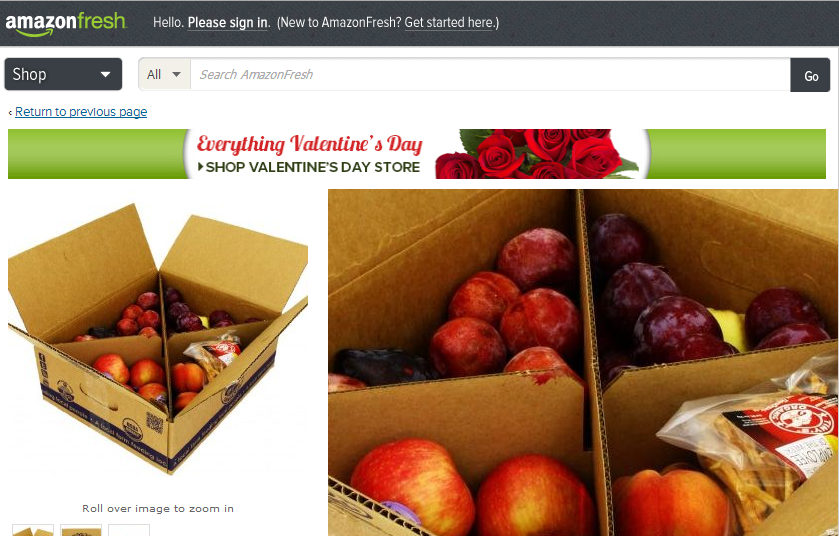
Amazon Fresh’s expansion, no-can soup shelf add thrill to online food shopping

With the advent of the computer and the Internet, everything seems to be within reach with just a click of the mouse.
In the last several years, online shopping has been booming, continuing to expand and increase in value. In February, the U.S. Department of Commerce reported $69.2 billion in e-commerce sales for the fourth quarter of 2013, an increase of 3.4 percent from the third quarter and 16 percent from the same period in 2012. The share of e-commerce in retail sales have also been steadily increasing.
Research groups point out that online grocery sales have also been pushing up despite a revenue drop during the recession. IBISWorld’s latest industry report said the years leading to 2018 show promising growth for online grocery because of declining unemployment and increased internet usage. With people more busy and with less leisure time, internet food shopping will become appealing and convenient.
Datamonitor also looks to grocery shopping as the “next star performer of online retailing” with the industry pushing hard to capture the interest of consumers.
Amazon’s Chief Executive Officer Jeffrey Bezos announced in their latest letter to shareholders the expansion of Amazon Fresh in more cities. The online retail giant promises to deliver fresh groceries in a matter of hours, using the service.
Prime Fresh members will only need to pay $299 a year to receive same-day and early morning delivery of fresh grocery items and other consumer goods.
Bezos said Amazon would also partner with local merchants to make the service more convenient and to help increase the selection of prepared foods and specialty items. The service was expanded to Los Angeles and San Francisco after a five-year trial run in Seattle.
Euromonitor’s Top 5 packaged food trends included the possible take off of online grocery with the new offering of Amazon.
“Online grocery shopping has been available for many years in the U.S. However, due to the low margins in the grocery business and the expenses involved in delivering door to door, online grocery services have not taken off and remain a niche offering that is only available in a few densely populated urban and suburban areas such as Boston, Chicago, New York City and San Francisco,” it said.
The report said the new delivery service “created considerable excitement,” especially with the option for customization with perishable goods.
This is good news for many perishable goods merchants, as well as packaged soup companies, courting younger generations of consumers, many of which may not like to spend time going to the store to buy their needs.
Under Amazon’s grocery and gourmet department, Campbell, Dr. McDougall’s, Progresso, Amy’s and other brands dominate the soup section. There are also gourmet products in the form of Soupman, among others.
Campbell and Progresso are undeniably the market leaders in the soup industry. With $8.1 billion worth of sales in 2013 and a market cap of $13.07 billion, The Campbell Soup Company (CPB) is able to retain its number one spot. Its soup business alone is worth $1.1 billion.
While Progresso remains at second place, it is backed by Forbes’ 48th most powerful brand in the world. Progresso is just one of the products under General Mills (GIS), which has a market cap of $29.9 billion and sales of $17.43 billion.
Both products are among Amazon’s featured brands and have hundreds of items on sale at the popular merchant website.
No more cans
It is interesting to note that Amazon’s soup shelf, which more or less represents what is being sold in ordinary groceries, features a collection of products in different containers. Gone are the days when ready-to-eat soup is only packaged in bulky and heavy cans.
Campbell, of course, keeps its classic flavors like chicken noodle soup in cans, perhaps to ensure customer familiarity with the product and to bank on brand loyalty and reputation. But many of its new product lines are in microwavable cups and bowls.
Among the soup brands, some of the gourmet products are embracing the Tetra Pak because they cater to a more sophisticated consumer group that is more discerning when it comes to health and the environment. Progresso’s “artisan” soups and Soupman’s signature flavors are now in Tetra Recart packaging, which is meant to replace tin cans.
Euromonitor data shows that soup sales continue to remain stagnant and at some point are declining because of consumer sentiment against processed and canned goods. Many analysts believe that the can packaging of soups are turning off consumers. Not only are cans heavy, they also have large carbon footprints. Younger generation of consumers associate cans with old-fashioned foods as compared to soup in other containers, which seem fresh and appealing.
Now the trend is to go with stand-up pouches, which grab attention for all the right reasons. Pouches are easier to open and can serve as a “billboard” because of the easy to read surfaces of products that come in boxes or pouches.
This trend pushed the envelope further with new packaging designs. While Campbell released last year a range of limited edition tomato soup cans as a tribute to painter and pop icon Andy Warhol, Soupman has been dishing out packaged soup in colorful and bold Tetra Pak pouches.
Soupman Inc. (OTC: SOUP), which started out as a in-demand restaurant in New York City, has been offering a couple of its famous soup varieties – chicken noodle, lobster bisque, lentil, tomato bisque, crab corn chowder, chicken gumbo and jambalaya – in over 4,000 supermarkets and in Amazon.
The company believes that the eye-catching package graphics, featuring its founder Al Yeganeh – who was more or less immortalized through the sitcom Seinfeld and the character “Soup Nazi” – will help increase sales. The same goes for its use of the Tetra Recart, a packaging technology that keeps the gourmet-quality soups fresh without the need for refrigeration.
According to Tetra Pak, the Tetra Recart is the first retortable carton package for shelf-stable products. The food is sterilized inside the pack and will stay fresh for up to 24 months. Tetra Pak is marketing it as “modern, innovative and renewable.”
As one of the more forward looking soup companies, Soupman is banking on its packaging for future retail success. And it just might work.
While soup sales is expected to decline, value may still rise as more people buy higher quality goods in the coming years. New packaging is a game changer in the industry that draws flak from the use of cans. Packages such as the Tetra Recart allow the sale of high-quality products in larger but lighter containers.
Analysts project that one day the canned food aisle will be replaced by stacks of pouches, with not only soup but other packaged food categories embracing the change.

jeudi 17 avril 2014

Amazon Dash: The Kindle of online grocery shopping?

Amazon Dash is a small wand that makes ordering new groceries a piece of cake
E-books had been around for a while before Amazon launched the Kindle. But the portable reader proved to be just the spark that digital reading needed to take off. Can Jeff Bezos wave his magic wand again with online grocery shopping? If so, then it might be because customers waved a magic wand of their own.
Much like the Kindle is a front-end device for Amazon's e-book business, Amazon Dash is a new front-end device for Amazon's same-day grocery service. If you subscribe to AmazonFresh, then Dash is going to make a lot of sense. The small wand has voice control and a built-in barcode scanner, and makes updating your grocery list a piece of cake.
So if you're baking cookies and run out of flour, just grab the Dash, hold down the voice button, and say "flour." Or if you want to order more of the specific brand you just ran out of, press the barcode button and scan the empty bag. And though Dash doesn't automatically order the items you add, they will be waiting for you in your queue the next time you log onto AmazonFresh.
Amazon has a habit of selling consumer gadgets for dirt cheap, and making all of its money on the content you consume for the gadget (see Kindle, Kindle Fire,Fire TV). As you might expect, we're seeing the same thing with Dash – only here it's being taken to a new extreme. The Dash wand will be free for AmazonFresh customers, provided they can snag an invite.
The only catch (well, apart from AmazonFresh's US$300 annual cost) is that very few of us can even use the service right now. As AmazonFresh is only currently available in the Seattle, Los Angeles, and San Francisco areas of the US, this might not mean a lot to you just yet. But it is a sign that the company has big plans to disrupt the grocery business. With that kind of ambition, it might not be long before the service starts popping up in other areas.

You can watch the video below for more info, and, if you live in one of those select AmazonFresh areas, you can sign up for an invite at the product page below.
Vidéo à la page http://goo.gl/xPMWaB

mardi 15 avril 2014

Amazon Makes Grocery Shopping Easier; Supermarket Execs Sound Off on eCommerce

As far as most folks are concerned, the actual shopping part of grocery shopping isn’t that bad. It’s the unloading-the-car portion of it that’s not exactly a good time. Loaded up with 12 rolls of toilet paper, an economy sized jug of laundry detergent and a case of soda – amongst all of the other odds and ends – reinforces the case for grocery delivery services like AmazonFresh.
Currently, shoppers on the Amazon website can buy quite a few grocery items. Whether it’s a bottle of Sriracha or 24 rolls of paper towels, there’s hardly a reason why Prime customers shouldn’t purchase at least some of their necessities online. And word on the street is that Amazon is making online grocery shopping even easier.
Named “Pantry,” Amazon is taking its Fresh model and is adapting it to the warehouse club store market. According to USA Today, “the service will be targeted at existing members of Amazon’s Prime shipping program. It will launch with about 2,000 products typically found in the center of grocery stores, such as cleaning supplies, kitchen paper rolls, canned goods like pet food, dry grocery items like cereal and some beverages.”
In a ComScore whitepaper titled Consumers Multi-Media Path to Purchase, which was released in March 2014, Amazon’s Pantry service was described as one that would target higher income households with kids. Set to launch sometime in 2014, Amazon plans to use set-size shipping containers up to a specific weight limit. Specific shipping costs weren’t named, but the overall price was described as “small.”
Beyond Pantry, Amazon is also introducing a tool called Dash, a barcode scanner that allows individuals to add items to their grocery list from home. Described by the editors at TechCrunch.com as “a Wi-Fi-connected device that allows users to build a shopping list by scanning bar codes and saying product names out loud … [the device] connects directly with AmazonFresh, the company’s grocery delivery service, so once your list is complete, it should be easy to make the purchase from your smartphone or laptop.”
Although Amazon’s foray into the grocery and consumer packaged goods segments sounds great for the general public, some executives at the top of those industries don’t agree. In fact, many are balking at the need for eCommerce for their businesses. ComScore included a few quotes from the opposition to explain why.
“We’re very much a brick-and-mortar company, with 97%-plus of our business done in-store, not online. People actually do like to go out and shop,” said Richard Galanti, CFO, Costco, in December 2013.
One month prior to Galanti’s quote, John Mackey, Co-CEO of Whole Foods explained that he hadn’t seen anyone produce a profitable or successful home grocery delivery business model. “We’re going to devote most of our attention and capital to what we think we do really well, which is open great new stores that are innovative and give great experiences to customers,” he said. “I do not think food retailing will be disinter mediated to the same degree that other businesses have.”
While others might not be as adamant about how eCommerce fits into the future of the CPG industry, the overriding theme is one of tentative action. “A growing chorus of brick-and-mortar food retailers are taking a wait-and-see approach to online grocery shopping and delivery,” the editors at Supermarket News explained.
At this point in the game, however, “wait and see” might just be too little too late. Taking the growth rates of eCommerce as an example, anyone who holds out will miss out on serious revenue.
“At more-than 11 percent growth Y/Y in Q4, desktop eCommerce continues to outpace overall retail, which grew 4%,” the editors at ComScore explained in their whitepaper.
To stay in the know regarding how eCommerce is evolving in the consumer packaged goods segment and beyond, subscribe to the NetSphere Strategies blog.

jeudi 10 avril 2014

Amazon Dash, la nouvelle arme de Jeff Bezos dans la bataille des produits frais

amazon-dash
Le géant de l’e-commerce américain a dévoilé samedi un nouveau projet grand public, baptisé Amazon Dash, un terminal connecté en wi-fi qui permet de commander des produits du quotidien. Ce scanner fonctionne via l’application Amazon Fresh, uniquement disponible au Etats-Unis pour l’instant.
Muni de cette télécommande, l’utilisateur peut à la fois scanner très simplement les produits qu’il souhaite recevoir, ou indiquer à l’aide du micro intégré le nom de ceux qui lui manquent, comme l’indique cette démo : 
https://www.youtube.com/watch?v=JLOzF0Y4Mqw (la vidéo ne semble pas fonctionner c matin)

Ce nouveau device simplifie immanquablement la commande de produits frais. Mais on peut aussi penser que le grand public, qui dispose déjà de multiples appareils ( tablettes, smartphones, PC), n’est pas certain d’adopter un énième device, alors que les applications de commande web-to-store existent déjà. C’est le cas par exemple  d’Instacart à San Francisco, un application innovante de livraison de produits frais en moins d’une heure.
AmazonFreshLa firme de Jeff Bezos parie donc sur la livraison rapide de produits frais grand public, un marché que vise l’ e-retailer depuis un bon moment. La plateforme Amazon Fresh, qui livre des produits le jour-même pour un montant minimum de 35 dollars, a ouvert à San Francisco, à Seattle et à Los Angeles. Amazon Fresh entend concurrencer des géants du retail comme Walmart ou Tesco.
En France, c’est le service du drive qui permet de récupérer rapidement des produits frais. En 2013, on comptait ainsi 2 800 drives ouvert par les principales enseignes hypermarchés, Leclerc, Carrefour et Intermarché en tête.

Source: http://goo.gl/Vsjj2E

mardi 8 avril 2014

Amazon Dash : faire ses courses depuis son domicile grâce à une télécommande !

Amazon a mis au point "Dash", une télécommande connectée au Wi-Fi et qui permet de faire ses courses depuis son domicile sur AmazonFresh, le service de livraison et d’alimentation d’Amazon.
Dash permet ainsi de faire ses courses depuis chez soi, au fur et à mesure de ce que l’on consomme. Comment ça se passe ? Très simple. Les commandes sont envoyées sur le site AmazonFresh, le supermarché d’Amazon. Ce dernier, en fonction de vos achats effectués, vous fait la livraison.
L’avantage de ce système est que le consommateur n’a plus besoin de stocker des aliments qu’il ne consomme pas immédiatement. On enrichit sa liste de courses au fil du temps. La télécommande Amazon Dash fonctionne en scannant les codes-barres des produits, et est également équipée de la reconnaissance vocale qui permet également de recommander un produit qui ne dispose pas de code-barres.
La télécommande Amazon Dash est proposée gratuitement pendant une période d’essai, est pour le moment disponible aux USA, en Californie du Sud, à Seattle et à San Francisco.

vendredi 14 mars 2014

50% de la population Américaine couverte par l'offre épicerie Amazon dès 2014 et avec sa propre flotte de véhicules. Amazon Fresh accelère et en profite pour réorganiser sa logistique.

Et si Jeff Bezos était en train de réaliser son rève ... couvrir dès 2014 50% de la population américaine avec une offre équivalente à 70% de ce qu'achètent les foyers au quotidien ...en produits, en matériel, en immatériel, en alimentaire.... Devenir le fournisseur principal de foyers clients ''connectés'' ... mutualiser les frais logistiques ... bénéficier en CA ''consolidé'' d'un panier moyen annuel dont je vous laisse imaginer le montant global ... Et enfin arriver à anticiper les achats ''mécaniques'' (80% des achats foyers)  donc ''mécanisables''. Whaou..!
Et si Jeff Bezos arrivait à libérer demain les foyers Américains - mais demain aussi les nôtres - de la ''corvée'' des courses, en lui faisant économiser de l'argent, en tirant partit de la vente de produits ''a marge'' (et en laissant aux autres les marché à faibles marges.... ) mais surtout en lui offrant un service sans équivalent devant sa porte avant 10 heures du matin ...
La lessive était une corvée, on a inventé la machine à laver.. les courses sont une corvée.. Amazon à inventé.. Amazon! 
Sans faire de triomphalisme, une fois de plus je constate que les infos remontant quotidiennement sur Amazon ne sont que des preuves que malgré les griefs et moqueries de certains petits camarades professionnels, réseaux ou amis, ma vision sur ce que j'avais identifié depuis plus de deux ans n'était pas si décalée que cela. On a souvent parlé de révolution industrielle... et si on parlait de la révolution ''commercante''.
Et d'enfin reconnaître que quand un leader investit durant 5 ans (soit plus du tiers de son existence) sur un ''test and learn''...comme Amazon à Seattle pour Fresh, il vaut mieux scruter à la loupe ce qu'il fait, analyser plutôt que dire ''jamais''. 
En pensant à eux, je me rassure en me disant qu'il vaut mieux être suivis que suiveurs... et que la vente en ligne avec livraison est une bénédiction pour les foyers !
Car quand les signaux faibles des pure players sortent de l'épaisseur du trait... la courbe décolle de manière exponentielle et devient irratrapable... c'est ce qui est en train de se passer aux Etats Unis pour ce qui est le marché jusqu'alors le plus protégé du e-commerce ... l'épicerie séche et les produits frais. Et nous continuons à penser que cela ne changera rien.
Et même si nous avons inventé le Drive, les dernières études prouvent que le service que tous les Foyers Français privilégie... c'est la livraison à domicile, à fortiori lorsque l'on est ''actifs'' avec enfants urbains, ou à l'inverse loin de tous commerces. 
LES FAITS :  50% de la population Américaine couverte par Amazon Fresh d'ici à la fin 2014... 
Si l'on veut bien regarder dans le rétro, l'annonce du déploiement, après 5 ans de test, du service "épicerie à domicile" faite par le leader de Seattle est très proche (Juin 2013) .
Donc après Seattle, Los Angeles, San Francisco, et les 20 zones ... dont l'europe, Amazon vient d'annoncer l'ouverture de 30 à 40 "marchés" (équivalent de nos bassins de population / zone de chalandise secondaire) d'ici à la fin de 2014.... 
Soit la moitié des foyers Américains ...
Et au dela de cette annonce, Amazon semble se diriger vers une réorganisation totale de sa logistique de transport, en réorientant l'organisation de sa logistique et de son mode de couverture des ''zones''. 
Cette organisation se décomposerait en 3 segments de zones, 3 niveaux proportionnels à la densité de population : 
- un premier niveau : les 40 marchés principaux annoncés ce jour, couvrant 50% de la population américaine, sera dorénavant couvert majoritairement par sa propre flottes de véhicules... les petits camions verts.. et demain des semis remorques... et sur cette zone, Amazon devrait regrouper les livraisons ''épicerie'' et ''produits frais'' dont les locaux, et les livraisons ''hors food''. Enfin, une mutualisation de moyens permettant de baisser drastiquement les couts de livraison, mais également d'amortir une flotte de véhicules sur une récurrence de livraisons mixant revenus à faible et à forte contribution. Oui livrer des carottes et des DVD sera donc possible. Le rêve de Bezos pourrait être exossé. Cela va poser des problème à l'US Postal, et à la Fed Ex.. comme nous le verrons plus loin. 
- un deuxième niveau : les 60 ''régions''à potentiels ''moyen'' en densité mais couvrant 17% des USA, servis par les transporteurs régionaux. Un marché qui là aussi devrait passer des acteurs nationaux aux locaux. FInalement une bonne nouvelle. 
- et enfin un troisième niveau, mais couvrant environ 30% de la population restante, couvertes par ... les partenaires historiques de Amazon US Postal et FedEx, les grands perdants de cette restructuration logistique. Ces deux acteurs se partageant depuis l'origine, une grande majorité des livraison de ce pure players, remplissant lors des périodes de fortes saisonnalités.. un semi-remorque toutes les 3 minutes
Les grands perdants : US Postal et FedEx dépossédée de la majorité du marché de la livraison Amazon... et devant se contenter des surplus et zones à rentabilité moindre car moins dense.
Et même si ce n'est certainement pas la cause principale, il faut voir aussi là une sanction vis à vis des problèmes rencontrés par Amazon lors des livraisons de Noël où l'US Postale et FedEx n'avait pas pu assurer la totalité des livraisons... Pour la première fois, Amazon avait du s'excuser et dédommager ses clients Prime en bons d'achat qui n'avait pas pu recevori leur commande pour le jour de Noël. 
Et enfin, cela permettra à Amazon non seulement de réduire les couts, mais d'inciter les foyers à regrouper leurs commandes Alimentaire et Non Alimentaires, mais d'avoir le contrôle sur la qualité de service de livraison. 
Donc oui le rêve de Bezos est peut être sur le point de se réaliser et la boucle de se boucler. Et 20 ans après de conforter un business modèle décrié, critiqué, repoussé par les acteurs en présence... mais avec lequel il va bien falloir composer. 
Car au delà du chiffre d'affaire ''grapillé'' au retail traditionnel et qui certes restera cantonné entre 12 à 15 % du commerce de détail global, le principal danger réside en deux points : ce sont les catégories profitables et récurrentes qui vont échapper au retail, et les habitudes d'achat des foyers avec un référent comme Amazon vont changer, ainsi que la perception du commerce dans sa globalité. Le danger est là.

lundi 10 mars 2014

Amazon Fresh arriva in Europa. Bezos punta il mercato alimentare

Quando un gigante come Amazon decide di entrare nel tuo mercato non ti rimane altra scelta che iniziare a tremare. E forse è quello che stanno facendo le aziende della GDO (grande distribuzione organizzata) dopo la notizia spifferata da San Francisco qualche ora fa. Il colosso di Jeff Bezos, dopo una sperimentazione più che positiva negli Stati Uniti d'America, è pronto a varcare i confini europei con un nuovo servizio: Amazon Fresh, cioè la possibilità di fare la spesa su Amazon. Vai sul sito, selezioni la pasta, il latte, le uova. Tutto ciò che ti serve, insomma. E nel giro di qualche ora ti arriva direttamente a casa.
Niente di eccezionale, vi starete dicendo. Del resto nelle grandi città ci sono alcune catene di supermercato che lo fanno già. Ma quando a proporre il servizio è Amazon, anche qualcosa di già esistente rischia di diventare rivoluzionaria, soprattutto perché il credo aziendale di casa Bezos è sempre stato quello di attaccare il mercato a suon di ribassi sui prezzi. Se sarà in grado di farlo anche con gli alimenti, può succedere di tutto.
Dalle notizie che trapelano da oltre oceano, Amazon Fresh dovrebbe debuttare nei prossimi mesi nel Regno Unito, molto probabilmente scegliendo Londra come città europea di lancio, dove è già possibile acquistare tè, pasta e cereali. L'espansione darà il via alla spesa tradizionale, rendendo possibile l'acquisto di prodotti freschi come in un comune supermercato.
Nelle città degli Stati Uniti dove Amazon Fresh è attivo, gli acquirenti che ordinano la spesa entro le 10 del mattino la ricevono a casa, grazie ai furgoni frigo verdi di Amazon, entro l'ora di cena. Ed è immaginabile che anche per il Regno Unito sarà così. Per una spesa superiore ai 25 dollari le spese di consegna sono azzerate, in alternativa si può scegliere il servizio Amazon Prime che in Italia costa 10 euro l'anno e azzera per 12 mesi qualsiasi costo di trasporto.
A proposito di Italia. Per il momento non si parla di Amazon Fresh nel nostro Paese. Ma lo sbarco in Europa è ormai un dato di fatto. E tutto lascia presumere che Roma e Milano possano presto diventare le nuove mete dei furgoni verdi di casa Bezos.

mardi 25 février 2014

Amazon Fresh, il servizio di consegna di generi alimentari arriva in Germania

Amazon è pronta ad espandere il business della sussidiaria Amazon Fresh. Il servizio di consegna di generi alimentari, soprattutto prodotti freschi, sbarcherà a Settembre in Germania ed in alcune regioni limitrofe.

La notorietà di Amazon ha cominciato a crescere quando la società aveva forma di un rivenditore di libri. La compagnia di Jeff Bezos è ora il più influente rivenditore online del mondo ed ha acquisito la sua posizione aprendosi nuove strade, diversificando il proprio business. Il commercio di Amazon tocca innumerevoli settori, dai libri ai mobili, passando per dispositivi elettronici – alcuni dei quali di sua stessa produzione, ed influenza il modo di acquistare i prodotti di molti paesi.
Non c’è da stupirsi troppo quindi se la compagnia con base a Seattle ha esteso i propri interessi anche alla consegna di generi alimentari. Il servizio prende il nome di Amazon Fresh ed opera attraverso l’omonima sussidiaria che ha mosso i suoi primi passi proprio nell’area metropolitana dove la società ha la sua sede principale.

Amazon Fresh

Il progetto è partito nel 2007 come un “beta-test” ad invito per poi prendere una forma più concreta a giugno del 2013 quando Amazon Fresh si è esteso ad alcune zone di Los Angeles e poi a dicembre a San Francisco, promettendo spedizioni puntuali tramite sottoscrizione ad Amazon Prime Fresh.
Attualmente Amazon sta ultimando le negoziazioni per assicurarsi il giusto numero di depositi ed una adeguata flotta di camion in “almeno quattro locazioni tra Germania, Austria e paesi limitrofi”. Con queste risorse Amazon porterà il servizio di Amazon Fresh nelle suddette aree, si suppone a partire daSettembre 2014.
I clienti potranno acquistare prodotti come frutta e verdura fresca, carne, pesce e prodotti caseari. Sebbene i numeri asseriscano che in Germania le persone preferiscano rivolgersi direttamente ai supermercati, il nome stesso di Amazon potrebbe contribuire alla crescita di questo servizio, creando un pericoloso avversario per aziende come Aldi e Lidl.
Source: GadgetBlog (http://goo.gl/PdqpLT)

mercredi 19 février 2014

Amazon fresh Los Angeles : La TV teste et les concurrents en parlent !

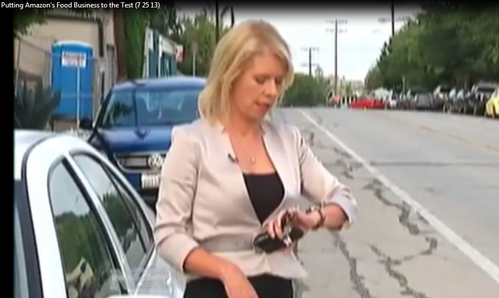
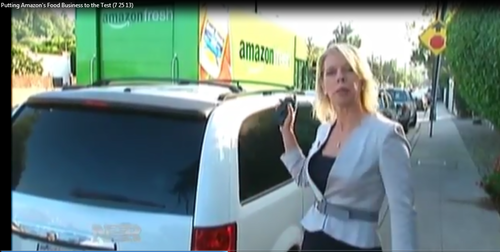
Oui je vais encore vous parler d'Amazon... j'insiste peut être et m'en excuse mais pour plusieurs raisons. Intéressant reportage repèré sur youtube sur l'arrivée du service Epicerie Amazon Fresh à Los Angeles ... et testé montre en main par les journalistes locaux. Un reportage à voir sur link. 
Amazon-fresh-los-angeles-le-furet-du-retail-2.png
http://www.youtube.com/watch?v=Fc0JeW9v4Oo
Pourquoi j'insiste ... ? Parceque pour avancer il faut regarder ce que font les plus audacieux ... 
Yves Puget expert de la distribution française le dit dans son édito du magazine LSA ''spécial commerce américain" du 30 /01 : ''nous souffrons probablement d'un manque d'audace''. Analyse qui explique remarquablement que la distribution française est certes l'une des meilleures du monde .. la preuve elle vient d'inventer le Drive ... néanmoins elle à vécu sur ses convictions et nécessite des réactions. Les ''même pas peur... '' et '' qu'ils viennent... '' ne sont plus convaincants. Car l'histoire du commerce n'est pas finie, et n'a pas forcément commencé comme on veut bien nous le raconter en 1963 à Ste Geneviève des Bois.
Doug Stephens référence du commerce international considéré comme The Prophet Retail au Canada avoue : 
"nous avons tendance à mesurer le bien fondé des idées d'Amazon en nous basant sur le monde que nous connaissons aujourd'hui. Je ne pense pas que Jeff Bezos fonctionne de cette façon... je le soupçonne d'avoir probablement 10 ans d'avance... Donc nous prononcer sur l'efficacité de la stratégie d'Amazon c'est très difficile. Nous n'avons aucun référent et toute réflexion ou opinion sont conditionnées par la réalité(et notre culture NDLR) du marché actuel... donc biaisé. Avec Amazon il ne faut jamais dire jamais''. 
Amazon-fresh-los-angeles-le-furet-du-retail-4.png
Le reportage confirme que les américains n'aiment plus aller en magasin(70% des français avouent que les courses sont une corvée sources Ipsos 2013) et d'autre part ont une vie ''bien remplie''... un service comme Amazon Fresh correspond à l'état dans lequel est la société américaine ... active.
Et regardez la réaction du CEO de YUMMY.com, l'un des concurrent local B&Mortar d'Amazon Fresh, et livreur de produits frais ... en moins de 30 minutes (après commande en ligne) dont la réaction m'a également conforté dans mes convictions: le e-commerce va se nourrir des parties ''rentables'' du monde physique à qui il ne restera ... que le reste. 
Amazon-fresh-los-angeles-le-furet-du-retail-7.png
Ce concurrent avouant qu'Amazon ne ''devrait pas les tuer mais leur enlever les 10 ou 15% de business les plus profitables''. Car n'oublions pas que la commande ne concerne pas que les produits frais, mais également l'ensemble de l'offre SM alimentaire de proximité, Hygiène beauté, entretien, pet food, biscuiterie frapiche etc ... (Amazon = 15% de CA Procter & Gamble aux USA.... voir mon post #Amazon s'installe directement dans les entrepots #Procter & Gamble ... encore un tabou qui tombe! ) 
Et souvenez vous, 30 minutes c'était la promesse de Pizz Hut, créateur du concept de la livraison à domicile de pizzas ... en 1995.
Car le défi d'Amazon au travers de son service et de son offensive sur cette catégorie de produits pouvant être le plus profitable (cf mon post Amazon Fresh : Les analystes financiers prédisent une forte rentabilité. ) est de livrer les foyers AVANT leur départ au travail. Entre la douche et la sortie du garage.. Après c'est plus rentable (point de retrait, bad expérience, taux de retour important).. Sans cette promesse, Amazon n'y serait pas allé. 
Bingo pour le test de cette journaliste, le créneau 7 à 8 heures est respecté. Livraison à 7h21.... 
      
Amazon-fresh-los-angeles-le-furet-du-retail-3.png
Le deuxième concurrent Webvan lui à préféré être racheté par Amazon ... Mais finalement l'acquisition de ce pionnier local, ayant toujours son enseigne, ne fait que renforcer la crédibilité du leader du e-commerce US. 
Amazon-fresh-los-angeles-le-furet-du-retail-6.png
Et pendant que l'on doute où faisons semblant de ne pas y croire... Amazon avance .. innéluctablement, et pas rentable.. Jusqu'à quand ? Intéressant isn't it ?
Ce qu'il faut retenir c'est qu'à force de ''ne pas y croire'', Amazon aura testé son concept, déployé à San Franisco et Los Angeles, avant d'ouvrir 20 sites durant cette année 2014. Mais quand ils s'implanteront, on criera au loup... mais trop tard.

vendredi 22 novembre 2013

Are Supermarkets Ready to Compete with Amazon?

Costco, WalMart, Target, Sam’s Club, Walgreen’s, Rite Aid, CVS…all of these companies have impacted and continue to impact the food retailing world. 

And then, there is Amazon…
"Amazon is the push that will make everyone change. Food retailers can’t dismiss it. They can’t say it’s too expensive, it’s too this, it’s too that," says Deborah Weinswig, an analyst covering retailing at Citi Research
Whether you like Amazon or not, it has changed…and is continuing to change the world.  Think about all of the data that supermarkets collect, and then think about Amazon and what it has learned from all of that data and how it uses that data to help itself and its customers!  They are a fierce competitor.  Just ask IBM, who lost out on a $600MM contract  with the CIA for cloud computing.  
Amazon is setting its sights on the food market…they are opening distribution centers with a variety of pick-up and delivery options.  They might be coming to your area. 

Are you ready to compete with them?


Source: http://goo.gl/ioojVY

mardi 11 juin 2013

Amazon: frutta e verdura adesso si comprano online

Amazon mira a conquistare il comparto alimentare con l'ecommerce dei prodotti freschi, AmazonFresh. Verdura, frutta e cibi in scatola per il take-away potrebbero approdare presto sulle nostre tavole direttamente con un click.

Amazon: frutta e verdura adesso si comprano online.
A Seattle già è realtà, altrove dobbiamo aspettare ancora un pò.
Jeff Bezos, CEO di Amazon , ha puntato alla catena del fresco per espandere il business del gigante dell’ecommerce. Frutta e verdura a breve non si compreranno al banco, o meglio, non al banco fisico, ma a quello virtuale delle vetrine di Amazon.
AmazonFresh è il comparto del commercio online del noto marchio che vende prodotti alimentari, da verdura e frutta fresca a cibi sigillati e prodotti da scaldare, pronti per un take-away alternativo.
Da Seattle il servizio si sta espandendo a Los Angeles ed entro il 2013 alla San Francisco Bay. Si vocifera che arriverà oltreoceano se le performance del nuovo business saranno soddisfacenti; questo significa che anche in Italia le abitudini d’acquisto dei prodotti del fresco potrebbero cambiare, iniziando a cliccare su Amazon non solo per libri ed elettronica, ma anche per ananas e insalate.
In caso di realizzazione di quelle che al momento restano solo delle ipotesi,l’infrastruttura logistica dei Paesi dove il servizio approderà dovrà conseguentemente adattarsi, per preservare la catena del fresco, portando il prodotto dal desktop alla tavola nelle migliori qualitative e con tempistiche contenute.
Amazon, al momento attivo con il nuovo servizio da sei anni circa nella città madre, dispone di propri magazzini ed effettua le consegne con propri automezzi. Occorrerà dotarsi di aree refrigerate a completamento dell’infrastruttura e questo potrebbe rendere necessario attivare delle partnership con altri player, portando in outsourcing parte della logistica.
Wal-Mart a San Francisco e FreshDirect a New York iniziano a temere  il competitor, anche se il mercato alimentare è abitato da player forti e non sarà una passeggiata lucrare profitti e conquistare fette significative della domanda.L’Italia, per esempio, ad oggi non è priva di realtà simili che compongono l’offerta del fresco online: Biobox –  che offre i propri prodotti biologici a Roma, Viterbo, Perugia e Terni, consegnando con cadenza settimanale o bi-settimanale per ordini online o via telefono da un vasto catalogo di prodotti del fresco – è solo uno dei tanti esempi che, soprattutto da Roma in sù, il nostro Paese vanta, prediligendo oltretutto l’agricoltura biologica.
AmazonFresh, pertanto, potrebbe non fare poi così tanto la differenza. La competizione si reggerà soprattutto sul servizio.
Source: Tech Fanpage (http://goo.gl/7HxGa)