Affichage des articles dont le libellé est restaurants. Afficher tous les articles

mercredi 9 avril 2014

Six Ways Tablets Are Changing Restaurant Customer Experience

In an effort to get out of the cold and snow I’ve been experiencing this winter, I decided to pack up my family and take them on a sun-and-sand-filled Caribbean vacation a short time ago. As with any enjoyable vacation, it ended too quickly and we found ourselves awaiting our flight home. While at the airport, we decided to visit the food court for a quick bite to eat. To my surprise, some of our well-known quick serve chains were there—and with long waiting lines to boot.
After selecting our restaurant of choice, we lined up, dreading the wait. As we made our way through the line-up, I was pleasantly surprised to see an employee of the fast food restaurant half way through taking orders on a wireless tablet. The goal was to take the orders in advance so when we reached the front of the line, all we had to do was pay and pick up our order. I was curious to see how well this would work with timing and order accuracy.
It worked for us. As we paid, our order was handed to us hot, fresh, and ready to be eaten. The long line suddenly didn’t seem so long anymore. Needless to say, my experience immediately improved at that moment, leaving me with positive feelings about the brand.
Tablets are a driving force behind innovations in the front-end restaurant customer experience, whether in a quick service or fast casual establishment. As more and more restaurants embrace tablet technology, there are several ways beyond my vacation experience that they are revolutionizing the restaurant experience for brands and consumers.
  1. Seamless Dining Experiences. Inspired by the ease of exceptional online buying events, guests value restaurants that provide seamless, hassle-free experiences from the moment they are seated through to the moment they pay their checks. In many cases, restaurants are using tablets to offer table-side check payment or other activities that streamline and improve the guest’s dining experience.
  2. Enhanced Interaction. Opportunities for enhanced interaction are prime targets for restaurants interested in improving customer experiences with table technology. Restaurants on the front line of tablet deployments have installed tablets at tables, allowing guests to interact with menus, place orders, pay bills and perform a range of other self-serve functions. Similarly, restaurants are exploring the use of promotional content or pay-as-you-go games that provide entertainment or customer engagement opportunities while guests wait for their food to arrive. These kinds of activities drive bottom-line improvements by leveraging customer experiences to increase loyalty.
  3. On the Fly” Data Insights. Tablets offer a non-threatening resource that restaurants can use to capture customer insights. While many guests are hesitant to provide personal information when they pay their checks or at the request of their servers, they are less resistant to providing data on their own terms, especially if the submission of data is tied to a discount or contest. Multi-site restaurants can leverage tablets to capture data insights at the local level, helping them tailor the customer experience to the desires and preferences of local consumers.
  4. Guest Reviews. A great time to capture guest reviews is before they leave the restaurant, while details on the experience are top of mind. Willingness to provide feedback is also much greater with this immediacy, since even the most satisfied guests often don’t feel compelled to rate their experience later. In the restaurant industry, reviews are a key element in customer acquisition, and table-side tablets offer a ready-made resource for encouraging guests to share feedback about service, cuisine or other aspects of their experience. Reviews captured via tablets can then be used to build brand reputation and modify the customer experience based on guests’ suggestions.
  5. Multichannel Feedback. Consumers use many different touchpoints to connect with the restaurant brands that are important to them. Surveys and other tools delivered on tablet devices create feedback that can be shared across all available channels, increasing the impact of brand advocacy and positive mentions. In particular, restaurants need to prioritize the use of tablets to capture feedback that can be distributed via social channels.
  6. Enhanced Employee Engagement. One of the largest challenges with customer feedback is how to use the results when they arrive. Tablets can help to reshape this challenge by bringing results to life in a meaningful way to the frontline. Data visualization capabilities on tablets are extensive, but again the challenge is more than to presenting guest feedback in a “pretty” way; it’s presenting it in a meaningful way that motivates frontline staff.
The real innovation in the use of tablet technology is that it enables restaurant brands to forge meaningful, direct connections among guests, restaurant managers and their frontline staff. The deployment of table-side tablets gives guests more immediate options, inviting them to participate in activities that strengthen their relationship with the brand.
Just as importantly, tablets can significantly improve a restaurant’s ability to capture feedback and provide local guest insights—determining factors in the brand’s ability to create and deliver enhanced customer experiences.

mardi 1 avril 2014

How Mario Batali’s Restaurants Are Fighting Food Waste

It’s become common knowledge that 40% of food in America goes uneaten.
To get our food from farm to plates we utilize 50% of all U.S. land, 10% of the total U.S. energy budget and 80% of all the freshwater consumed in the U.S.,reports the NRDC. Needless to say, if we waste less food, we would also waste less land, energy, and freshwater: all precious and finite resources.
But somehow people don’t care enough about this issue. Food waste isn’t sexy, and it doesn’t seem as outrageous a problem or as hot a topic as I think it should be.
My friend, food waste guru, and author Jonathan Bloom, once pointed out to me that today in America, food is everywhere: it’s in our pharmacies, gas stations, Big Box retailers; it’s abundant and ubiquitous and it gives us the impression that it is not precious. As Bloom says, “these increased food options communicate our abundance in a somewhat harmful way. They contribute to the sense that we have so much food that we don’t need to treat it carefully.”
It’s common parlance for parents to say to their kids: “there are children starving in other parts of the world, eat your string beans.” And logically, that doesn’t really make sense, I can’t put my leftover, half eaten dinner in a to-go container and ship it overnight to a hungry kid.
In 2012 the NRDC’s report on food waste points out that reducing food waste in America by just 15 % would save enough food to feed more than 25 million people annually.  In other words, the need to produce more and more food could be dramatically offset by reducing the amount that is wasted. Wasting less food would lead to major savings in the use of water, energy, pesticides and fertilizers, and would do wonders for the world’s food security, a new study by the UN’s Food and Agriculture Organization finds.
Any solutions to world hunger then, must start with a massive reduction in food waste.
Minimizing food waste is in a chef’s DNA. It affects food cost and the bottom line, and thus it’s in a chef and restaurant’s best interest not to let edible product go unused. But this doesn’t account for post-consumer plate waste, and frankly, there is always room for improvement even in the leanest of kitchens.

So what are we doing at B&BHG?

  1. Our restaurants are cook-to-order, so large batches of food are not prepared in advance of service, thus, rarely are large batches of food discarded at the end of a night.
  2. We are a chef-driven restaurant group, so our chefs are allowed creative freedom to create specials and manage the menu according to inventory- surplus or shortage.
  3. As a mostly- Italian restaurant group, we have more “European-sized” portions, and we offer the option for guests to take home leftovers.
But no matter how many precautions we take, food waste is inevitable. So when we do end up with food waste, our restaurants compost. But composting is only one stop short of the landfill. Ultimately, food goes uneaten. So our restaurants have taken a few more aggressive steps.
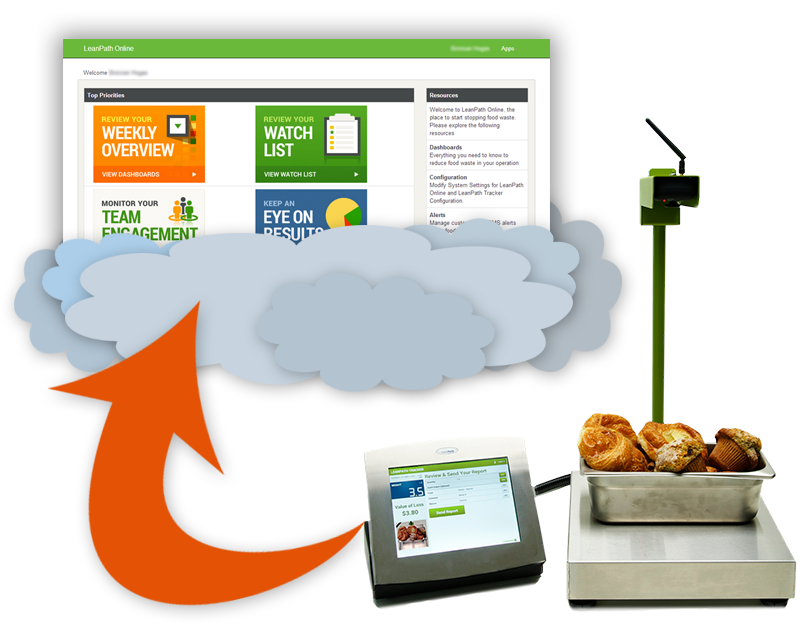
tracker-to-LPO_cloudGraphic
Before throwing away any pre-consumer food waste (resulting from overproduction, expired items, trimmings, etc.) our staff places food on a Lean Path scale and records critical data about each transaction, including the food type, weight, estimated value, reason for disposal, and more. From their cloud-based analytics platform, we can instantly view comprehensive waste data and insights. We worked with Lean Path for 90 days at two of our restaurants. Today, we’re working with Lean Path to create a smaller model for cook-to-order restaurants so we can better analyze our consumption.
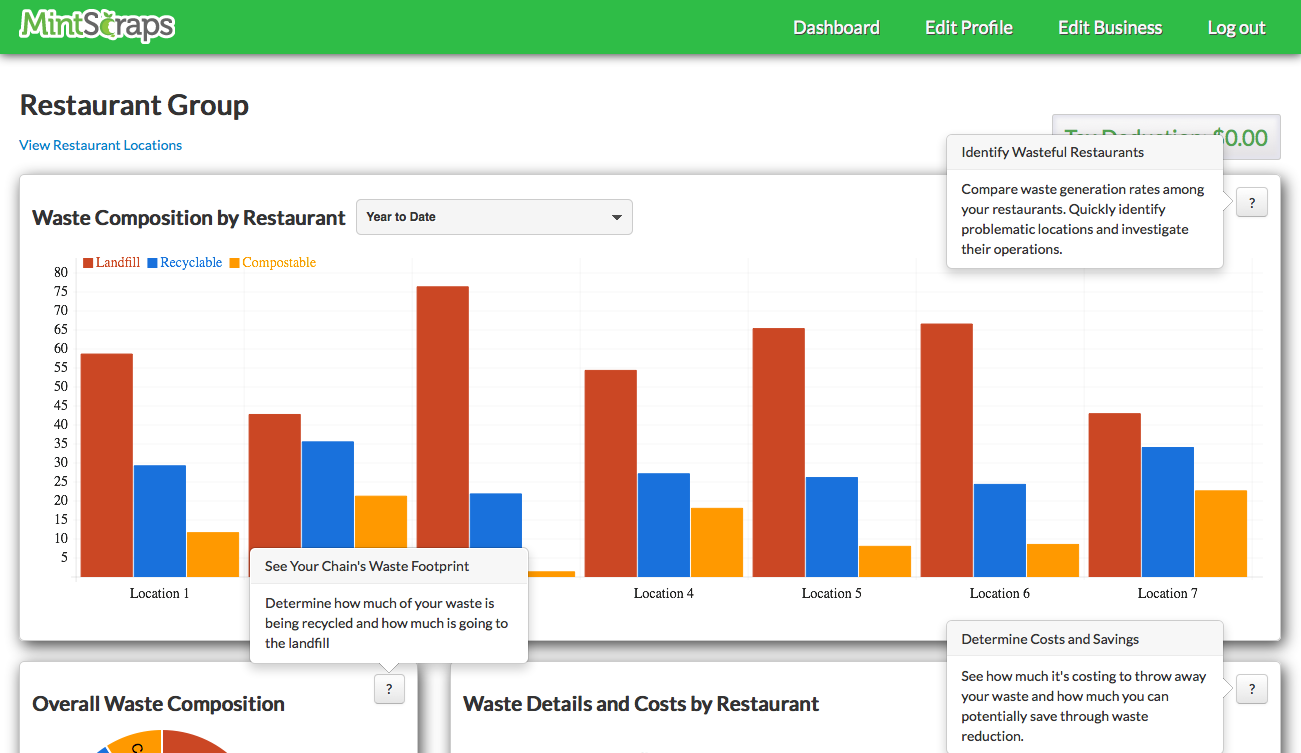
mintscraps_main_dashboard2
MintScraps is another cloud-based platform but it starts with a different dataset: trash, recycling and compost bags picked up each night. MintScraps creates real-time charts and graphs that allow us to spot trends and identify inefficiencies in our operations. We can compare waste generation across each of our locations and identify aberrations. Additionally, through MintScraps Marketplace, our restaurants can post their leftover food for pickup by local food banks, which can also result in tax deductions.

So what’s the takeaway?

Numerous experts have proclaimed the need to double the world’s food supply in the next 40 years to feed a growing population with changing dietary demands. However, because of food waste, doubling the food supply actually will require tripling production from fewer resources. For this reason it’s even more urgent that we get our food waste problem under control.
Instead of teaching our children to feel guilty after they don’t finish what’s on their plates (they are children after all, I’m an adult and sometimes my eyes are still bigger than my stomach) – we should reverse the damage that has been done and teach them how truly precious food is. Show them the 3 minute video by artist and farmer Matthew Moore that brought me to tears – that squash takes 55 days to grow.
Teach them the value of what they are putting in their mouth, not the idea that they are taking it out of someone else’s.

mardi 11 février 2014

Technomic: Soup, salad drive restaurant traffic

Soup and salad can be effective ways not only to boost sales, but also to draw traffic, according to Technomic, Inc.
The restaurant research firm found that many consumers go to restaurants specifically because they enjoy the soups or salads there. They are particularly attracted to premium ingredients.
“Soup and salad are traditional favorites, but consumers still expect variety and something different on the menu,” Technomic executive vice president Darren Tristano said in a press release announcing the publication of “Left Side of the Menu: Soup & Salad Consumer Trend Report.
“Catering to consumers’ need for variety when dining out — while also striking a balance between craveable, healthy, and innovative yet familiar offerings that justify price points — will be important in driving soup and salad purchases.Operators may also have room to ramp up soup and salad orders by promoting their appeal across dayparts and mealparts,” he added.
Here’s Technomic’s breakdown of soup and salad trends:
Source: Technomic, Feb. 2014

jeudi 19 décembre 2013

Report: Restaurants are failing at customer experience

After polling more than 25,000 customers across numerous industries, ForeSee has found that restaurant brands are lacking when it comes to providing a good customer experience. The company, which released its Experience Index this week, found that only four restaurants scored high enough to make it into the report. Although Pizza Hut, Starbucks, McDonald's and KFC made the cut, none reached the standard for excellence, a score of 80 or above.
The ForeSee Experience Index features four scores: Satisfaction, Retention, Upsell, and Word of Mouth Index (WoMI).
  • For "Satisfaction" ratings, Pizza Hut scored 79, followed by Starbucks at 78, McDonald's, with 76 and KFC, with 72.
  • Retention rates were 83 at Pizza Hut, 80 at Starbucks, 81 at McDonald's and 78 at KFC.
  • Upsell scores and Word of Mouth Index were the lowest for these restaurant brands. Pizza Hut had a 66 and 50, respectively; followed by Starbucks, with 64 and 46; McDonald's, with 65 and 37; and KFC, with 59 and 36.
  • "Companies in this (restaurant) industry — those listed, and especially those not — need to take note and use a scientific methodology to measure and manage their customer experience in order to determine exactly where they are falling short in satisfying their customers," the report said.
    Satisfied customers
    Also, the Future Behavior Index compares less-satisfied customers (with Satisfaction scores of 69 or less) to highly satisfied customers (with Satisfaction scores of 80 or higher) of the top Hospitality & Food Services brands to produce likelihood scores of Future Behaviors. According to the report, highly satisfied customers of the top Hospitality & Food Services brands are:
    • Preference: 81 percent more likely to prefer the brand or company over others.
    • Retention: 64 percent more likely to continue doing business with the brand or company in the future.
    • Upsell: 98 percent more likely to purchase additional products or sign up for additional services from the brand or company.
    • Future Purchase: 75 percent more likely to purchase from the brand or company the next time they purchase the types of products the brand or company offers.
    • Recommend: 72 percent more likely to recommend the brand or company to someone else.
    • Trust: 72 percent more likely to count on this brand or company to act in their best interests, consider the brand or company to be trustworthy, and trust the brand or company to do what is right.
    Satisfaction drivers
    In order to increase sales, retention, and recommendations, brand executives need to know how to increase satisfaction, the report said. The ForeSee methodology measures several drivers and the methodology calculates the relative impact of various elements on overall satisfaction. The elements that will have the most impact on satisfaction (and, therefore, future behaviors) differ for specific brands. The following chart shows the top priority elements for the companies in the Hospitality & Food Services category:
    Product
    The products offered by this company are "desirable, unique and perform their intended purpose."
    • 50 percent for Pizza Hut, Starbucks
    Service
    The company "keeps its promises about the delivery of services. The employees are friendly, and the services provided by the employees are consistently performed."
    • 50 percent for KFC, McDonald's
    Price
    The products "provide value and are worth the price. This company's prices fairly reflect the benefits provided by the products."
    • 25 percent for McDonald's
    "A good customer experience is a critical driver of financial success, so it should be measured and managed the right way ... Whether executives know it or not, their customers have evolved to a point where they're in charge. They can buy anything, anywhere, anytime. Technology has made them smarter than ever before. Social media has given them a voice and a megaphone to broadcast their opinions. And, with more choices of brands and ways to engage with them (web, mobile, contact center, store/location, social media, email, etc.) at their disposal, it's easier than ever to switch whenever they deem necessary," the report said.
    Source: FastCasual (http://goo.gl/pLxXRk)

mercredi 30 octobre 2013

Les tendances 2014 en restauration rapide

Un article publié dans « Les Échos de la Franchise » détaille les tendances de l’année 2014 en matière de restauration rapide. D’après les experts du secteur, 3 nouvelles tendances seront à l’honneur l’année prochaine : « l’ExoStreet », le « Veg&thic », et la vente au poids.
D’après les experts du secteur, 3 nouvelles tendances seront en effet à l’honneur l’année prochaine : « l’ExoStreet », également appelé le « snacking globe-trotter » avec des plats à emporter d’inspiration latine, sud-américaine, indienne ou africaine ; le « Veg&thic », qui mettra l’accent sur la qualité et les produits sains ; et la vente au poids, qui répondra aux clients attentifs aux prix. Face à cette nouvelle concurrence, les concepts classiques (sandwiches, burgers et pizzas) devront s'adapter. Ceci pourra notamment passer par une montée en gamme.Enfin, les experts annoncent le retour du « fait maison » dans des offres snacking généreuses et chaudes.

How Mobile Technology Is Changing the Way We Dine Out

Mobile technology is changing the way we eat out—from how we choose a restaurant and make a reservation to the way we order, pay the bill and share the experience with others. But are diners really better off? Photo Illustration by F. Martin Ramin/The Wall Street Journal, Styling by Anne Cardenas; Marcus Nilsson/Gallery Stock (salmon); Brett Stevens/Gallery Stock (salad)
OVER THE MANY years I made my living as a restaurant critic, I dined out 5,123 times, not counting the office cafeteria and numerous airport eateries that I described as "fast food served slowly." Whenever people learn about my immoderate profession, they invariably ask, "How did you choose where to go?" My strategy was quite simple, at least in the unplugged 1980s: I asked around. Then came the World Wide Web, with its breathtaking search capabilities and lightning interactivity. This spawned all sorts of restaurant voting sites, as well as a nationwide upsurge of self-anointed restaurant reviewers sounding off around the clock, issuing so many contradictory opinions that they can be more confusing than constructive.
The past decade has seen many tech innovations when it comes to dining out, but no truly life-altering advancements—until now. Mobile technology is revolutionizing the way diners interact with restaurants, for better and worse. While new apps are expanding, accelerating and streamlining the dining experience, the ubiquity of smartphones can eclipse some of the very reasons we eat out: relaxation, discovery, camaraderie and a fleeting escape from our machine-driven lives. In certain respects, mobile devices are also tipping the balance of power from restaurants to consumers—from "Take it or leave it" to "Do what we want, or 1,232 friends will hear about it right now." To be sure, before long, smartphones will do everything short of plucking a mint at the coat check.
Bypassing the human in this way seems akin to buying World Series tickets and then watching the game on the jumbotron.
With mobile technology you can search endless options, cross-referenced every which way. All of the larger dining sites—Zagat, Yelp, Urbanspoon and Citysearch among them—have taken the mobile leap. As a result, dining decisions can be increasingly spontaneous, impulsive, collaborative and easy to change at the last minute. I have discussed this trend with restaurateurs where I live, in New York's Hudson Valley, and not all are sanguine about it. They are concerned that this freewheeling new approach could exacerbate every restaurateur's bête noire: no-shows. As it is, on any weekend evening, a typical fine-dining establishment might expect 25% or more of their reserved customers to blow them off, without even bothering to call and cancel. (This is why restaurants overbook.) Then again, reserving electronically can increase accountability. The online reservation service OpenTable, which has more than 28,000 member restaurants and seats more than 12 million diners a month, sends hand-slapping emails to no-shows, and deactivates users after four personal fouls in a year. Perhaps the biggest change in the mobile world is the way in which diners make their decisions. Not only do they search on the run, but they also digitally collaborate with friends in the process—cuisine by consensus.
If you haven't noticed, a lot more restaurants, particularly the hip and crowded, are not accepting reservations. There are two main reasons: It projects that something irresistibly exciting is going on, and tables turn faster, which boosts income. Previously, had you entered a Pamplona-like scene and been quoted a wait time of between an hour and infinity, you would have had two options: Stand around sipping overpriced cocktails, or just stand around. Now mobile apps like NoWait and Diner Connection allow you to check in at the front desk, leave your phone number, then linger wherever you like. The restaurant sends automated text messages updating your status, and guests can communicate with the restaurant in real time. So, if you are, say, having a jovial time of it at a nearby pub, you can push back the booking (or cancel it).
In some locations, chains like Applebee's and Chili's are betting on customers' preference for the convenience and relative anonymity of the touch screen; digital tablets at tables allow one to order food and drinks without so much as consulting the waiter. Maybe it's me, but bypassing the human in this way seems akin to buying World Series tickets and then watching the game on the jumbotron. This timesaving technology is being adopted primarily by casual or chain restaurants, where diners seldom need servers to expound on the laminated menu; it's unlikely we'll see this mode of ordering anytime soon in upscale institutions. "It doesn't work in my situation," declared Kevin Boehm, co-owner of the Chicago-based Boka Restaurant Group, which includes such luxe venues as Balena and GT Fish & Oyster. "When you lose the experience of ordering with somebody who can give you an intelligent answer, you lose, well, hospitality." The place where mobile ordering is gaining ground the fastest is in the carryout and delivery trade, with services like GrubHub and Seamless.
The ubiquity of smartphones can eclipse some of the very reasons we eat out: relaxation, discovery, camaraderie and a fleeting escape from our machine-driven lives. Photo Illustration by F. Martin Ramin/The Wall Street Journal, Styling by Anne Cardenas; iStockphoto (dumpling)
It's at the conclusion of the dining experience that the touch screen is likely to become a more common sight at a wide range of establishments in the next few years. Apps that allow customers to tally and pay their tabs electronically eliminate the process of having a server present the bill, walk away, return for the credit card and then ring it up in the back. Programs like Tabbedout and Cover are competing not only for the casual trade but also for upscale restaurants in situations where time is a concern (think business lunches). OpenTable is testing a mobile payment program in San Francisco with hopes of rolling it out by the end of the year.
Some apps advertise that they can automatically divvy up the check for groups of diners, avoiding the annoying back-and-forth over who had the extra margarita; most offer nifty ways to calculate tips. The question of what percentage is an appropriate reward for servers whose role might soon be redefined as "dish fetchers" is one that, as far as I am aware, no app has yet promised to tackle.
As someone who has happily nibbled his way around the globe, toting the kind of pad that needs no charging, it's easy to dismiss this mobile craze as the height of overkill—like roaring a Maserati to the corner deli. Truth is, back in those lower-tech days, I'd have loved to have had that tip calculator, and the ability to instantly check a waiter's math skills. And who needs lingering in the foyer?
You may not learn the waiter's name and hometown, but he's not going anywhere. Ultimately, no amount of technology will alter the immutable reality: that dining out is, above all, about fun. And what's not fun will sink like a dropped soufflé—something you can watch right at your table, on YouTube.

Mobilize Your Meal
Smartphone apps that aim to enhance your dining experience
Illustration by Jesse Lefkowitz for The Wall Street Journal
Pick a Restaurant
Out on the town but unsure where to eat? Thousands of smartphone-wielding citizen reviewers are here to help. The ubiquitousYelp (free, iOS and Android), which has been around for almost a decade, has the greatest breadth of options and quantity of reviews. Specialized restaurant-only review apps, in particular Urbanspoon (free, iOS and Android), can offer more nuanced guidance for the discerning diner. Along with each restaurant's menu, Urbanspoon includes reviews from users, newspapers and blogs. Devoted users of Foursquare (free, iOS and Android) are beginning to see customized real-time recommendations pop up on their phone: If you're walking through Little Italy, Foursquare can tell you, based on your past check-ins and other Foursquare users' tips, not only which pasta place is worth trying but what you should order once inside. The new pop-up feature is available on all Android devices now and is being rolled out on iOS platforms.
Illustration by Jesse Lefkowitz for The Wall Street Journal
Make a Booking
OpenTable (free, iOS and Android) is still the go-to app for making a reservation, either far in advance or on a whim. The app tells you when the restaurants nearest you (or in any specified location) have openings and lets you book with a few taps of a finger. If toggling between apps tires you out, you can also access OpenTable's reservation system directly through the Yelp and Facebook FB -0.78% mobile apps. Beyond offering reviews and tips (like which nearby places have outdoor patios), OpenTable can help you get into an impossible-to-book restaurant at the last minute. "It never hurts to check the day before at the most popular restaurants in case a reservation falls through," said Jocelyn Mangan, OpenTable's vice president of consumer product management. "We send reminders 24 hours in advance, and that tends to be when cancellations happen."
If you still can't get a table at that hot restaurant—or if said restaurant is so hot it doesn't take reservations—you may just have to show up. But thanks to new services likeWaitAway and BuzzTable that are available to restaurants, you no longer have to stand shoved against a crowded bar with a germy buzzer sticking out of your handbag. Instead, you just give your phone number to the host, wander wherever you'd like and you'll get a text message when your table is ready. The NoWait app (free, iOS only), set to launch nationwide in January, takes this convenience one step further, putting the power in diners' hands: You don't even have to leave your home to get in line. Browse the app for average wait times in your area, choose where you'd like to dine and breeze into the restaurant right when your table is ready.
Illustration by Jesse Lefkowitz for The Wall Street Journal
Order In
Phoning in a food-delivery order is just so 2011. These days, if you want takeout or delivery fast, just launch an app. Since your credit-card information is saved within the app, you can summon a different cuisine to your door every day of the week without the hassle of fishing out your wallet. Even better: These services come at no cost to the diner and make their money by taking a percentage (usually around 10%) off the order directly from the restaurant.
The mobile takeout-ordering market is booming. GrubHub and Seamless (both free, iOS and Android)—which merged earlier this year but are, for the moment, keeping their brand identities distinct—have a network of more than 25,000 restaurants all over the U.S., spread across more than 500 cities and 350 college campuses, with an average of 130,000 orders processed a day. Eat24 (free, iOS and Android), another online food-delivery behemoth, works with roughly the same number of restaurants and processes "tens of thousands of orders" every day, said its CMO, Amir Eisenstein. Eat24's recent partnership with Yelp—which enables Yelp addicts to place their orders directly through their preferred interface—has made ordering food online even easier.
Illustration by Jesse Lefkowitz for The Wall Street Journal
Pay Your Bill
The bother of waiting around for a check, or struggling to figure out how much everyone owes, is a thing of the past. With mobile-payment apps, you can now pay your dinner bill (or, even more conveniently, bar tab) and calculate tip, all from your smartphone. Tabbedout (free, iOS and Android) currently works in 5,000 restaurants in major markets all over the country, while the newer app Cover (free, iOS) is NYC-only for the moment. OpenTable will also be rolling out a mobile-payment feature in San Francisco later this year.
Illustration by Jesse Lefkowitz for The Wall Street Journal
Find a Happy Hour
Wherever you are, there's probably a $5 martini within spitting distance. Happy hour apps like DrinkOwl (free, iOS and Android) and Happy Hour Finder (free, iOS and Android) can steer you to the most happening bars and most alluring drink specials around the country.
Illustration by Jesse Lefkowitz for The Wall Street Journal
Follow Your Diet
HealthyOut (free, iOS and Android) makes it easy to stick to your diet without getting stuck in your house. Whether you're practicing vegetarianism, trying to cut down on sodium or following a diet trend (Paleo, South Beach, even the China Study), just tap in your "dietary desires" and the app will present you with a list of approved dishes at restaurants in your vicinity. Diners with serious gluten allergies should also consider Find Me Gluten Free (free, iOS and Android), which provides crowd-sourced tips on the best gluten-free restaurants and dishes in any given area: which places have a dedicated toaster for their gluten-free bagels; which ones have a special on-request menu. As with all apps that rely on user input, Find Me Gluten Free will become even more useful as more and more customers add their pointers.
Illustration by Jesse Lefkowitz for The Wall Street Journal
Share Your Meal
Foodspotting (free, iOS and Android) is the ultimate social-media app for the food-obsessed. Devoted foodies take and post pictures of favorite dishes, which other users then mark as "wanted," "tried" or "loved." Tastemade (free, iOS; Android coming soon) takes this food-ogling artistry to the next level, with user-generated video restaurant reviews. Tastemade makes it easy (and fun) for even total filmmaking tyros to shoot and edit glossy one-minute video capsules on their phones.

mardi 29 octobre 2013

This Week in Food Innovation: From Slow-Cooking to Fast Food and Everything in Between


ThisWeekinFood.jpg
With Halloween festivities more or less underway this weekend, the holiday season is just around the corner and shopping aside, I imagine most of us are anticipating yet another stretch of eating, drinking and making merry. Here, we'll look at several stories related to the former. Service and packaging notwithstanding, some of these news items aren't explicitly related to design, but they certainly hold lessons for designers of all stripes.
First up, a couple of articles that examine food as a 'manufactured' product; not so much the industrial food complex but rather the entrepreneurial, product-driven side of how and what we eat. In contrast to, say, the riveting true stories behind Apple or Twitter —tech companies whose success is precisely why they remain compelling to the general public—food may seem an unlikely area of innovation. Yet it's an interesting topic for almost the exact opposite reason as bleeding-edge technology: Although food is essential to our continued existence in a way that iPhones and followers are not, we remain (at times blissfully) unaware of where, exactly, it comes from. From prepping potatoes by the pallet-load to harvesting hundreds of hectares of jalapeños, we got a closer look at the unsung line cooks and idiosyncratic entrepreneur behind New York City's Balthazar and Southern California-based Huy Fong Foods (of Sri Racha fame), respectively.
Balthazar-MarvinOrellanaforNYT.jpg
Photo by Marvin Orellana for the New York Times
I'll spare you the NYC-insider take (the restaurant is around the corner from Core HQ), but Willy Staley does well to establish the context of Balthazar's 'downtown-ness,' setting the scene with Soho's manufacturing heritage before diving into the details, which might apply to any major restaurant operation. Of course, this being Lower Manhattan, the stakes (cue rimshot) are higher, and restauranteur Keith McNally's iconic brasserie would not have become a veritable institution if not for its quality and consistency. "During the busy season—roughly fall Fashion Week to Memorial Day—the restaurant spends $90,000 a week on food to feed some 10,000 guests."
I highly recommend the custom-styled/art-directed Times Magazine feature "22 Hours in Balthazar " to non-NYCers and non-foodies alike: local flavor and jargon aside, it's a fascinating case study in both service design and how things are made.
Roughly one in 10 people who enter Balthazar orders the steak frites. It is far and away the restaurant's best-selling dish, and Balthazar can sell as many as 200 on a busy day. A plate of steak and potatoes requires a tremendous input of labor if you're going to charge $38 for it. At a smaller restaurant, cooks are typically responsible for setting up their own mise-en-place—preparing food for their stations—before each service begins, but at Balthazar, things are necessarily more atomized. The fries, for example, go through numerous steps of prep, done by a few different people, before they wind up on a plate.
(I should also add that the Frites video makes for a fascinating contrast to theMac Pro manufacturing vid that has made rounds this week...)
ChiliPeppers-AmitDaveforReuters-viaQuartz.jpg
Photo by Amit Dave / Reuters, via Quartz
Sri Racha, on the other hand, should need no introduction, though a bit a backstory is in order. Roberto Ferdman of Quartz reports that David Tran founded Huy Fong foods shortly after he landed in Los Angeles in 1980.Longing for the signature spice of his native Vietnam, made his own hot sauce (the ingredients read "Chilis, sugar, salt, garlic, distilled vinegar," plus a few less savory preservatives) and started selling it in the now-iconic squeeze bottle with the green cap as a community service. The rest, of course, is history: Rooster sauce, as one of my friends calls it, is now a staple in all variety of Asian eatery and beyond.
The story is as piquant as its subject matter as it shifts its focus on the famously reclusive Tran, who seems humble to the point of obliviousness. "The only hope he ever harbored was to provide Vietnamese immigrants with a hot sauce worthy of their pho soup," Ferdman writes. "Growing a bona fide business wasn't an afterthought—it wasn't a thought at all. 'I started the business with my eyes closed. There were no expectations at all,' he said." The challenge, then, is not so much a matter of developing new products but simply figuring out how to scale up production... but you'll have to read the article to find out what "separates [Sri Racha] from the competition."
MarysMarinatingStick-SallyRyanforNYT.jpg
Left: Photo by Sally Ryan for the New York Times
Scaling up, of course, requires diligence and savoir-faire at all levels. If the kitchen also remains the closest thing to a laboratory that most of us have access to, it comes as no surprise that the proverbial heart of their home is the site of all variety of outsider innovation... as we witness every year at theInternational Home + Housewares Show . And although we tend to covet kitchen gadgets that are expressly deemed to be designed objects, such asCrucial Detail's Porthole cocktail infuser (see also: our Afterschool podcast with designer Martin Kastner ), it's easy to overlook the utility of objects that just plain work—we missed Mary's Marinating Stick at the IHHS this year (maybe I walked by thinking it was another take on the Corkcicle ).
But considering that Mrs. Hunter of Gary, Indiana, spent just under two decades bringing her eponymous product to market, it's worth reading the chronicle of a hapless home inventor who has finally realized her delicious dream. Along the way, 73-year-old Hunter hired I.D.'er David Smith to refine the design, which looks something like a cross between a baster syringe and a tea infuser, and had fellow churchgoers spread the word as chefs declared the marinating stick to be superior to injection-based alternatives... which led to a reality TV pitch and finally distribution by Target this holiday season.
NaturalMachines-Food3Dprinter-viaWSJ.jpg
Where Mary arrived at her insight through experimentation and a stroke of (perhaps divine) inspiration, this week also saw news of a breakthrough in 3D printing food : Barcelona-based Natural Machines (placeholder site as of press time) can extrude up to six materials in a single job, with a heated build platform to boot. Frankly, I don't necessarily find it unappetizing—I'd rather be 'processing' foods myself than buying them from shelves—but I don't really see the point. Nor does Wall Street Journal's Ben Rooney, who wasn't particularly impressed by the portrait that Natural Machines produced in ketchup in his video report:
In a rather more lighthearted look at postmodern foodways (PMFW), The Atlantic identifies a baker's dozen delivery diners , from the Introvert to the Dinosaur, citing an AM New York clipping about Gothamites' web-enabled dining habits. But perhaps the most interesting takeaway message (pun intended) is an insight from a related New York Times article, also linked in the "Taxonomy of Food Delivery Diners," from a couple of weeks ago. It turns out that Fast Food, Not Fine Dining, Tops Expense Account List —business travelers on the company dime are more inclined to simply sustain themselves in transit than to charge boozy client dinners for accounting to sort out later.
...the latest quarterly report from a major expense-account software-management firm called Certify [ranks restaurants] by the frequency with which they turn up on expense accounts. Certify says that the rankings are based on analysis of "millions of business receipts from the past three months" from its corporate clients...
No. 1 in most-expensed restaurants was Starbucks, followed by McDonald's and Subway... in the report's top-rated restaurants, a category where restaurants are ranked aspirationally rather than just on frequency of purchases, the top five are Jimmy John's, Chipotle, Chick-fil-A, Panera Bread, and (ready for this one?) Dunkin' Donuts.
Shrinking per diems and austerity measures are obviously a factor, but I was also interested to learn about another criteria for discerning diners: "The availability of Wi-Fi. That always is a driver. A lot of people say, If I have to choose between a restaurant that has Wi-Fi and one that doesn't, I'm going to go with the Wi-Fi." It's a weird, imperfect feedback loop of our tech-enhanced (or addled) age: we're equally inclined to order food online as we are to seek Internet connectivity in harshly-lit, sweet-n-sour-smeared environs.
Meanwhile, yet another fast food phenomenon was duly noted in the Times, though it might be foreign to non-motorists: "paying it forward " refers to footing the bill for the folks behind you in a drive-through.
You could chalk it up to Southern hospitality or small town charm. But it's just as likely the preceding car will pick up your tab at a Dunkin' Donuts drive-through in Detroit or a McDonald's drive-through in Fargo, N.D. Drive-through generosity is happening across America and parts of Canada, sometimes resulting in unbroken chains of hundreds of cars paying in turn for the person behind them...
Perhaps the largest outbreak of drive-through generosity occurred last December at a Tim Hortons in Winnipeg, Manitoba, when 228 consecutive cars paid it forward. A string of 67 cars paid it forward in April at a Chick-fil-A in Houston. And then a Heav'nly Donuts location in Amesbury, Mass., had a good-will train of 55 cars last July.
I guess I've been missing out on an uncanny slice of Americana... though somehow I doubt that the McDonald's at the corner of Atlantic and Vanderbilt sees many Big Mac benefactors. Author Kate Murphy speculates that anonymity is paramount, and as much as the concept of the drive-through speaks to American car culture, it's certainly a delightful twist on an otherwise transactional interaction.
Lastly, in an unexpected case of innovation in a resource-constrained context, rapper Ja Rule is apparently penning a 'microwave cookbook '; his newfound expertise thanks to a 20-month stint in prison (no word on whether he's continued to hone his craft since he was released in May). But given the breadth of variation between microwave ovens—each with its own power scale and dead spots—I suspect that the equipment matters as much as the technique.
Source:  Core77 (http://goo.gl/QRavB2)