mercredi 23 avril 2014

Decoding the New Consumer Mind: How and Why We Shop and Buy

A decade of swift and stunning change has profoundly affected the psychology of how, when, and why we shop and buy. In Decoding the New Consumer Mind, award-winning consumer psychologist Kit Yarrow shares surprising insights about the new motivations and behaviors of shoppers, taking marketers where they need to be today: into the deeply psychological and often unconscious relationships that people have with products, retailers, marketing communications, and brands. 
Drawing on hundreds of consumer interviews and shop-alongs, Yarrow reveals the trends that define our transformed behavior. For example, when we shop we show greater emotionality, hunting for more intense experiences and seeking relief and distraction online. A profound sense of isolation and individualism shapes the way we express ourselves and connect with brands and retailers. Neurological research even suggests that our brains are rewired, altering what we crave, how we think, and where our attention goes.
Decoding the New Consumer Mind provides marketers with practical ways to tap into this new consumer psychology, and Yarrow shows how to combine technology and innovation to enhance brand image; win love and loyalty through authenticity and integrity; put the consumer’s needs and preferences front and center; and deliver the most emotionally intense, yet uncomplicated, experience possible. Armed with Yarrow’s strategies, marketers will be able to connect more effectively with consumers—driving profit and success across the organization.

Un ebook en vente à l'adresse http://goo.gl/3uU218

The Effects of Situational Factors on In-Store Grocery Shopping Behavior: The Role of Store Environment and Time Available for Shopping

We conducted a field experiment to explore the effects of two situational factors, store knowledge and time available for shopping, on consumers' grocery shopping behavior. The results indicate that these two factors have an impact on such shopping behaviors as failure to make the intended purchases, unplanned buying, brand and product class switching, and purchase volume deliberation. The findings also suggest that the information processing activities that mediate these relationships differ across shopping conditions. Implications for managing the grocery store environment that may advance current practice are offered.

Une étude universitaire de 13 pages au format PDF
A télécharger à la page http://goo.gl/LNypuo

Rethinking Innovation

Rethinking Innovation: Forget radical breakthroughs, start with the customer need

When we hear the word ‘innovation’, we tend to think about eureka moments leading to radical breakthroughs, such as businesses creating totally game changing products like Google Glass. But often innovation is more straightforward than that - simply improving the way we meet existing customer needs, not inventing new products.
Why should your organisation care about innovation? Because it’s the essential ingredient for growth: innovation delivers added value to your customers, and provides a competitive edge in the marketplace.
So here are three lessons in innovation taken from our experiences at Thrive:

1.    Don’t focus on the product, focus on the customer: Opportunity lies in customer and channel innovation. Look at graze.com, the website that delivers boxes of healthy snacks to workplaces. The team behind Graze focused on the customer need: busy people at work don't have time to nip out to get a healthy snack, so instead they tend to grab what’s around the office such as crisps and biscuits. Graze offers a healthy snack box conveniently mailed straight to the customer, offering introductory discount codes and trial offers to encourage take-up. This in turn, nurtures word of mouth referral. The company doubled its sales in 2012 and launched in the US last year!
2.    Inject an entrepreneurial mindset: Effective innovation relies on an entrepreneurial mindset that embraces factors such as agility and speed. Innovation is best driven by a commitment to better solve customer needs, turning a negative (a customer headache) into a positive (an innovation opportunity). Organisations need to think like start-ups, through experimentation and rapid iteration, using technology to put working prototypes in front of the customer.
3.    Reframe the process: Effective innovation relies on asking questions and solving problems, liberated from a process-driven approach. Our experience is that responsibility for innovation is often delegated to junior brand managers; yet it would be better tasked to the more experienced thinkers who are often better at making decisions using their gut instinct rather than relying on process. Remember that most good ideas arise not out of an innovation brief but from an organisational culture that encourages creativity and experimentation.
New technologies are also important as they are changing both the way consumers shop, and also how we innovate solutions to better serve their needs. Technology presents some great opportunities for innovation: look at the emergence of mobile sites and apps where consumers browsing recipes on their mobile devices are able to shop directly for ingredients. This kind of interaction is promising to disrupt deep-rooted behaviour and brand loyalty.
At Thrive we have huge experience in the ‘free-from’ food market, which has seen a lot of innovation in the development of products for coeliacs and those who are gluten, wheat and dairy intolerant. In this market we’ve seen great examples of best-practice innovation. New food brands have emerged and the sector has had to raise its game in order to cater for this new audience. Successful innovation in this sector has therefore not been about radical breakthroughs, but the normalising of the customer experience. Those with an intolerance don't want to be made to feel like they have a problem when buying ‘special needs’ packaged goods, they want to have a normal experience, being seduced by products just like in any other food category.
Up to 20% of the UK population believe they have some sort of food intolerance or allergy when in reality only 5% have been diagnosed. Market insight has also identified that 16.5% of the UK population are regularly buying gluten-free products, despite many having no gluten allergy. 
In this market, one of the biggest customer headaches is that it can be hard to get all ‘free-from’ food in a single shop. Food company ilumi focused on this consumer problem, innovating a simple and attractive solution: making these foods easily accessible by selling a range of tasty ready meals direct-to-consumer. In the future, expect to see more innovations in other areas where the consumer is currently poorly served such as vending machines, snack foods and foods on the go.
Of course, it’s no coincidence that some of the emerging ‘free-from’ brands started out at the founder’s kitchen table, often constrained by small budgets. Such constraints help innovation thrive by being forced to be agile and flexible in order to test and adapt their ideas ( i.e. by adopting the entrepreneurial mindset outlined in #2 above).
So try to shake-up how you approach innovation in your business. Whatever category you’re in, whether you’re a retailer or a manufacturer, there is great scope for innovation in improving the way you meet existing consumer needs. In an increasingly competitive marketplace, you need to innovate to stand out from the crowd.

Amazon’s Magic Wand and the Unrelenting Race to Make Shopping More Convenient

In the last two months, Amazon has spotlighted two new products that allow shoppers to add items to their shopping list without ever typing anything into a search bar. This isn’t a coincidence.
The most recent one is Amazon Dash — a thin, wand-like device, revealed on Friday, that includes both a microphone and a barcode scanner. Speak into it or scan a box of cereal or pack of toilet paper to automatically add that product to your AmazonFresh shopping list. For now, it is available only on a trial basis to Amazon customers in San Francisco and Los Angeles who pay for Amazon’s new Prime Fresh membership, which includes grocery delivery.
Before Dash, Amazon announced in February that it was adding a technology called Flow to its main shopping app on mobile phones. A user taps on the Flow feature in the app, points the phone at a product in their home — say, a book or a bottle of shampoo — and Flow is supposed to quickly display the product page on the phone’s screen.
Both Dash and Flow seem a bit gimmicky now. And I have no idea whether either will ever move past that stage and toward mass adoption. But they are both signs that Amazon is seriously thinking about how to remove as much friction as possible for people who are looking to buy a specific item from Amazon, but are on the move and not sitting behind a desk staring at a computer screen.
In an interview earlier this week, Paul Cousineau, Amazon’s director of mobile shopping, said that his division spends a lot of time thinking about how to make it easier for shoppers using touchscreen devices to quickly find the products on Amazon they want to buy.
“If you never had to type again on a phone that would be great,” he said. “We want you to go from ‘I want that’ to ‘I bought that’ in 30 seconds or 10 seconds … a very short period of time.”
And the hope is that Flow will eventually lead Amazon to that future. “I’d like to see this be our primary search model,” he said of the Flow technology.
As for the Amazon Dash device, it’s a different approach to the same company goal of giving its shoppers the quickest path to load a bunch of goods into their shopping cart wherever they might be. Is it that hard to look in your cabinet at the brand of pasta you are running low on, and then search for it on Amazon at the laptop on your kitchen table? No, not even close. But, thanks in large part to Amazon, we are living in a time where speed and convenience in shopping often seem to trump all, for better or worse. And Amazon is placing a small bet that using the Dash device will be quicker and more convenient.
If it’s not, we’ve still learned two things about Amazon’s approach. First, if there were any remaining doubts that Amazon is dead serious about expanding its grocery business, they should now be gone. And second, the company is investing time and money into planning for a future where the search bar on Amazon websites and apps becomes the less convenient shopping tool.

mardi 22 avril 2014

Une imprimante 3D alimentaire pour les personnes âgées développée dans le cadre d’un projet européen

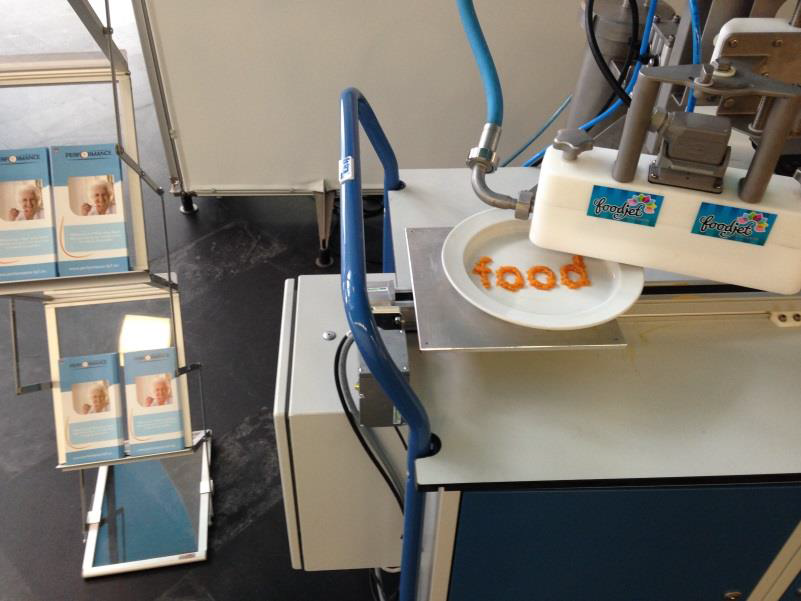
L’agence allemande Biozoon Food Innovations, en partenariat avec FOODJETcoordonne dans le cadre du projet européen PERFORMANCE un projet d’imprimante 3D alimentaire pour les personnes âgées.
A l’instar du projet porté par Gel Manche dans le cadre du Concours Mondial d’Innovation 2030, cette solution innovante doit permettre de reconstituer les aliments à la texture modifiée dans leur forme initiale au moyen d’une imprimante alimentaire 3D.

Imprimer les aliments en 3D pour

teaser_seneoproL’imprimante 3D est développée dans le cadre du projet PERFORMANCE associant des industriels, des universitaires et des institut de recherche. Le projet est financé à hauteur de 3 millions d’euros.
L’imprimante 3D doit permettre d’imprimer des aliments à la texture modifiée en leur donnant différentes formes. Chaque cartouche de l’imprimante contiendra un aliment différent, légumes, viande, glucides, sous forme liquide.
Performance, imprimante 3D
Grâce à l’ajout d’un agent liant (en cours de développement), l’imprimante déposera la matière en couches successives pour reconstituer les aliments sous une forme donnée, grâce à une tête d’impression de 48 buses. Le résultat final permettra aux personnes âgées d’avoir des repas à la texture modifiée appétissants.
Le projet PERFORMANC devrait voir le jour en 2015.
Vidéo de présentation du projet PERFORMANCE

4 Ways American Grocery Shopping Is Changing Forever

The grocery industry in the U.S. is undergoing some of the most dramatic changes since supermarkets emerged in the 1940s, according to retail analysts.
Whereas a single store once served all of shoppers' food and beverage needs, consumers are now buying groceries across more than a dozen retail channels.
"In the 1990s and the beginning years of this century, the greatest threat to supermarkets and grocery stores came from supersized 'one-stop shopping' venues like supercenters and warehouse clubs," the market research firm Packaged Facts wrote in its most recent annual report on emerging grocery trends. "Today the threat is spread out among all retail channels, including drugstores, dollar stores, limited assortment chains, and — the elephant in the room — e-commerce."
Here are some of the top trends that are changing the grocery shopping landscape.
1. Consumers are shopping for food and beverages across multiple channels. On average, consumers shop at five different types of stores to fulfill their grocery needs, according to Deloitte's 2013 American Pantry report. Examples of shopping channels include supermarkets (like Kroger and Safeway), supercenters (such as Wal-Mart), discount, convenience, club, and e-commerce stores. 
Consumers aren't hitting multiple stores because they can't find everything they need in one place, according to Packaged Facts analysts. The trend is driven by the fact that few stores offer the precise mix of value, quality, and private label brands that consumers are looking for. 
2. Private label is gaining popularity. Sales of private-label groceries are projected to grow 62% to $133 billion in 2016, up from $83 billion in 2008, according to a Packaged Facts survey. The growth can primarily be attributed to the recession, since house brands are typically cheaper.
But private label isn't just about price — it's also about quality. "More than 90% of consumers believe private-label solutions offer the same or better value versus their national brand counterpart, and more than 80% believe the quality is the same or better," according to an IRI report.
3. Shoppers want more product curation. "When a customer walks into a store of 40,000 items and only wants to buy 30 of them, that's a terrible customer experience," said Chad Arnold, president and CEO of the online grocery service Door to Door Organics.  "Companies are now scaling back stores and getting them more focused to specific customers, instead of a one-store-fits-all approach."
The average square footage of supermarkets in the U.S. has been falling since 2006, and is now roughly 46,000 square feet, according to Packaged Facts. 
"The pendulum definitely is swinging back to smaller store formats," analysts wrote, noting that Wal-Mart is expanding its smaller-format stores. Kroger also has a small-format store called Turkey Hill Market, which averages about 6,800 square feet.
Online grocers, such as Door to Door Organics, have web tools to curate products for customers. The tools can recommend products based on previous purchases, recipes, or even food allergies.
4. Fresh produce is a main driver for consumers in deciding where to shop.Seventy-five percent of consumers say the produce department is the most important, followed by fresh meat, poultry, and seafood (60%); store brand products (36%); local farm foods/produce (35%); and the in-store bakery (29%), according to a Packaged Facts survey.

Amazon Fresh’s expansion, no-can soup shelf add thrill to online food shopping

With the advent of the computer and the Internet, everything seems to be within reach with just a click of the mouse.
In the last several years, online shopping has been booming, continuing to expand and increase in value. In February, the U.S. Department of Commerce reported $69.2 billion in e-commerce sales for the fourth quarter of 2013, an increase of 3.4 percent from the third quarter and 16 percent from the same period in 2012. The share of e-commerce in retail sales have also been steadily increasing.
Research groups point out that online grocery sales have also been pushing up despite a revenue drop during the recession. IBISWorld’s latest industry report said the years leading to 2018 show promising growth for online grocery because of declining unemployment and increased internet usage. With people more busy and with less leisure time, internet food shopping will become appealing and convenient.
Datamonitor also looks to grocery shopping as the “next star performer of online retailing” with the industry pushing hard to capture the interest of consumers.
Amazon’s Chief Executive Officer Jeffrey Bezos announced in their latest letter to shareholders the expansion of Amazon Fresh in more cities. The online retail giant promises to deliver fresh groceries in a matter of hours, using the service.
Prime Fresh members will only need to pay $299 a year to receive same-day and early morning delivery of fresh grocery items and other consumer goods.
Bezos said Amazon would also partner with local merchants to make the service more convenient and to help increase the selection of prepared foods and specialty items. The service was expanded to Los Angeles and San Francisco after a five-year trial run in Seattle.
Euromonitor’s Top 5 packaged food trends included the possible take off of online grocery with the new offering of Amazon.
“Online grocery shopping has been available for many years in the U.S. However, due to the low margins in the grocery business and the expenses involved in delivering door to door, online grocery services have not taken off and remain a niche offering that is only available in a few densely populated urban and suburban areas such as Boston, Chicago, New York City and San Francisco,” it said.
The report said the new delivery service “created considerable excitement,” especially with the option for customization with perishable goods.
This is good news for many perishable goods merchants, as well as packaged soup companies, courting younger generations of consumers, many of which may not like to spend time going to the store to buy their needs.
Under Amazon’s grocery and gourmet department, Campbell, Dr. McDougall’s, Progresso, Amy’s and other brands dominate the soup section. There are also gourmet products in the form of Soupman, among others.
Campbell and Progresso are undeniably the market leaders in the soup industry. With $8.1 billion worth of sales in 2013 and a market cap of $13.07 billion, The Campbell Soup Company (CPB) is able to retain its number one spot. Its soup business alone is worth $1.1 billion.
While Progresso remains at second place, it is backed by Forbes’ 48th most powerful brand in the world. Progresso is just one of the products under General Mills (GIS), which has a market cap of $29.9 billion and sales of $17.43 billion.
Both products are among Amazon’s featured brands and have hundreds of items on sale at the popular merchant website.
No more cans
It is interesting to note that Amazon’s soup shelf, which more or less represents what is being sold in ordinary groceries, features a collection of products in different containers. Gone are the days when ready-to-eat soup is only packaged in bulky and heavy cans.
Campbell, of course, keeps its classic flavors like chicken noodle soup in cans, perhaps to ensure customer familiarity with the product and to bank on brand loyalty and reputation. But many of its new product lines are in microwavable cups and bowls.
Among the soup brands, some of the gourmet products are embracing the Tetra Pak because they cater to a more sophisticated consumer group that is more discerning when it comes to health and the environment. Progresso’s “artisan” soups and Soupman’s signature flavors are now in Tetra Recart packaging, which is meant to replace tin cans.
Euromonitor data shows that soup sales continue to remain stagnant and at some point are declining because of consumer sentiment against processed and canned goods. Many analysts believe that the can packaging of soups are turning off consumers. Not only are cans heavy, they also have large carbon footprints. Younger generation of consumers associate cans with old-fashioned foods as compared to soup in other containers, which seem fresh and appealing.
Now the trend is to go with stand-up pouches, which grab attention for all the right reasons. Pouches are easier to open and can serve as a “billboard” because of the easy to read surfaces of products that come in boxes or pouches.
This trend pushed the envelope further with new packaging designs. While Campbell released last year a range of limited edition tomato soup cans as a tribute to painter and pop icon Andy Warhol, Soupman has been dishing out packaged soup in colorful and bold Tetra Pak pouches.
Soupman Inc. (OTC: SOUP), which started out as a in-demand restaurant in New York City, has been offering a couple of its famous soup varieties – chicken noodle, lobster bisque, lentil, tomato bisque, crab corn chowder, chicken gumbo and jambalaya – in over 4,000 supermarkets and in Amazon.
The company believes that the eye-catching package graphics, featuring its founder Al Yeganeh – who was more or less immortalized through the sitcom Seinfeld and the character “Soup Nazi” – will help increase sales. The same goes for its use of the Tetra Recart, a packaging technology that keeps the gourmet-quality soups fresh without the need for refrigeration.
According to Tetra Pak, the Tetra Recart is the first retortable carton package for shelf-stable products. The food is sterilized inside the pack and will stay fresh for up to 24 months. Tetra Pak is marketing it as “modern, innovative and renewable.”
As one of the more forward looking soup companies, Soupman is banking on its packaging for future retail success. And it just might work.
While soup sales is expected to decline, value may still rise as more people buy higher quality goods in the coming years. New packaging is a game changer in the industry that draws flak from the use of cans. Packages such as the Tetra Recart allow the sale of high-quality products in larger but lighter containers.
Analysts project that one day the canned food aisle will be replaced by stacks of pouches, with not only soup but other packaged food categories embracing the change.